


The AI Maturity Curve: Five Stages Insurers Move Through on the Way to Agentic Underwriting
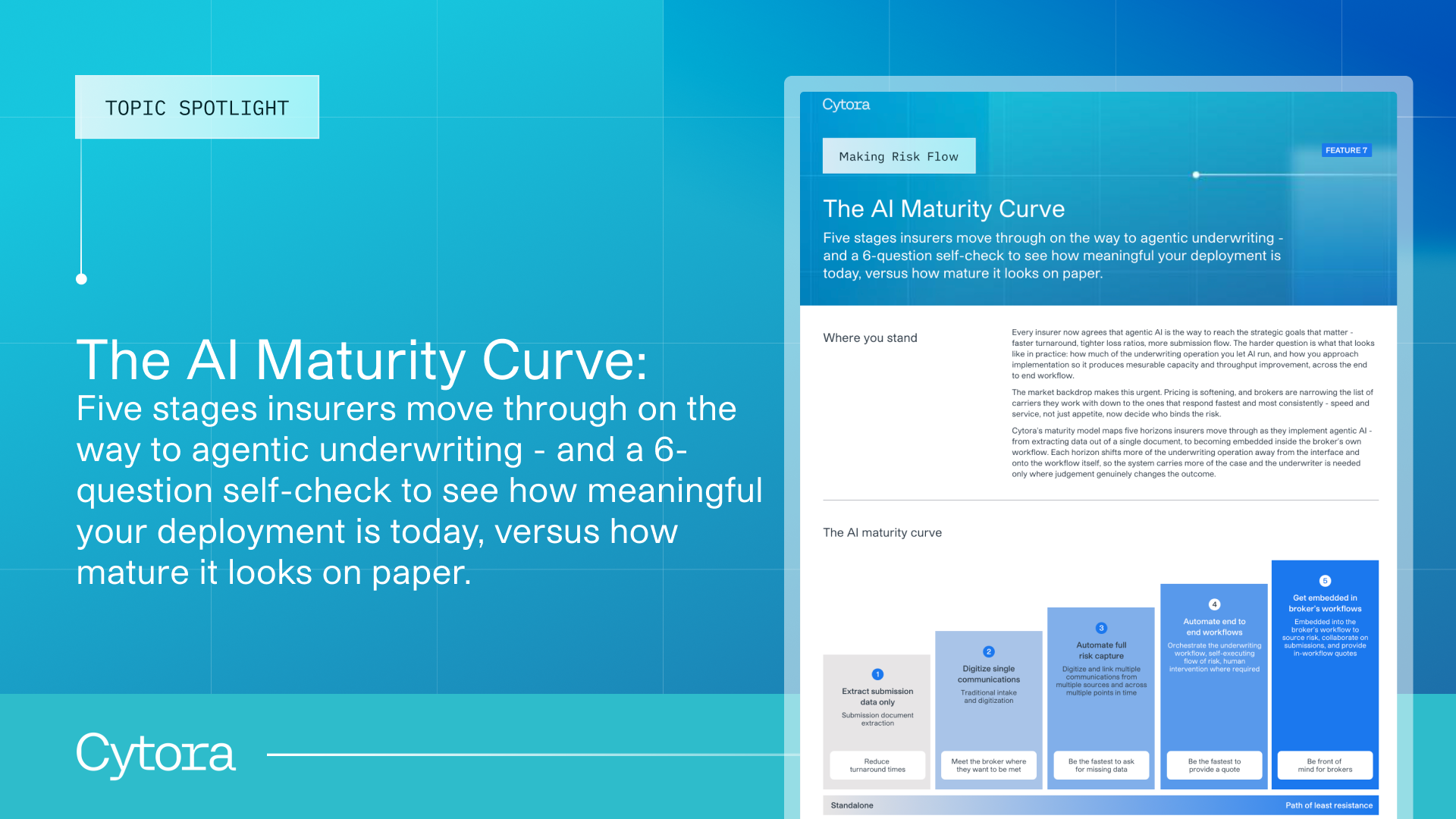
Every insurer agrees agentic AI is the path to faster turnaround, tighter loss ratios, and stronger submission flow. The harder question is what that looks like in practice — how much of the underwriting operation you actually let AI run, and whether your implementation produces measurable capacity and throughput gains across the end-to-end workflow.
The market backdrop makes this urgent. Pricing is softening, and brokers are narrowing their carrier list down to whoever responds fastest and most consistently. Speed and service — not just appetite — now decide who binds the risk.
The Five Horizons of AI Maturity in Underwriting
Cytora's maturity model maps five stages insurers move through as they scale agentic AI — from extracting data out of a single document, to becoming embedded inside the broker's own workflow:
- Extract submission data only
- Digitize single communications
- Automate full risk capture — the real inflection point, where every communication links into one live view of the risk
- Automate end-to-end workflows — appetite checks, pricing, and chasing run without manual clicks
- Get embedded in brokers' workflows — sourcing, collaborating, and quoting inside the broker's own system
From horizon three onward, insurers stop being reactive and start becoming the path of least resistance — capturing more submission flow as brokers consolidate around the carriers that are easiest to work with.
Find Your AI Maturity Archetype
This guide includes a 6-question self-check across three dimensions of your operation — digitization & intake, decisioning & workflow automation, and embeddedness & distribution. Score yourself on each, and your lowest-scoring dimension reveals your current archetype:
Advanced Digitizer but Not End-to-End — Clean, structured data in, but decisioning is still stitched together by hand.
Decisioning Leader but Unscalable — A fast, automated decisioning engine held back by manual intake.
Advanced but Standalone — Strong digitization and decisioning, but not yet embedded in broker workflows.
Your Next Move
Wherever you land, the fix is the same: identify your weakest dimension, automate the highest-volume, lowest-judgment step first, and prove the model before scaling further. The carriers pulling ahead aren't the ones with the most AI — they're the ones fixing their weakest link first.
Download the Guide: The AI Maturity Curve
Take the self-check and find out where your underwriting operation stands today.
Download
The AI Maturity Curve: Five Stages Insurers Move Through on the Way to Agentic Underwriting


Get the latest from Making Risk Flow

